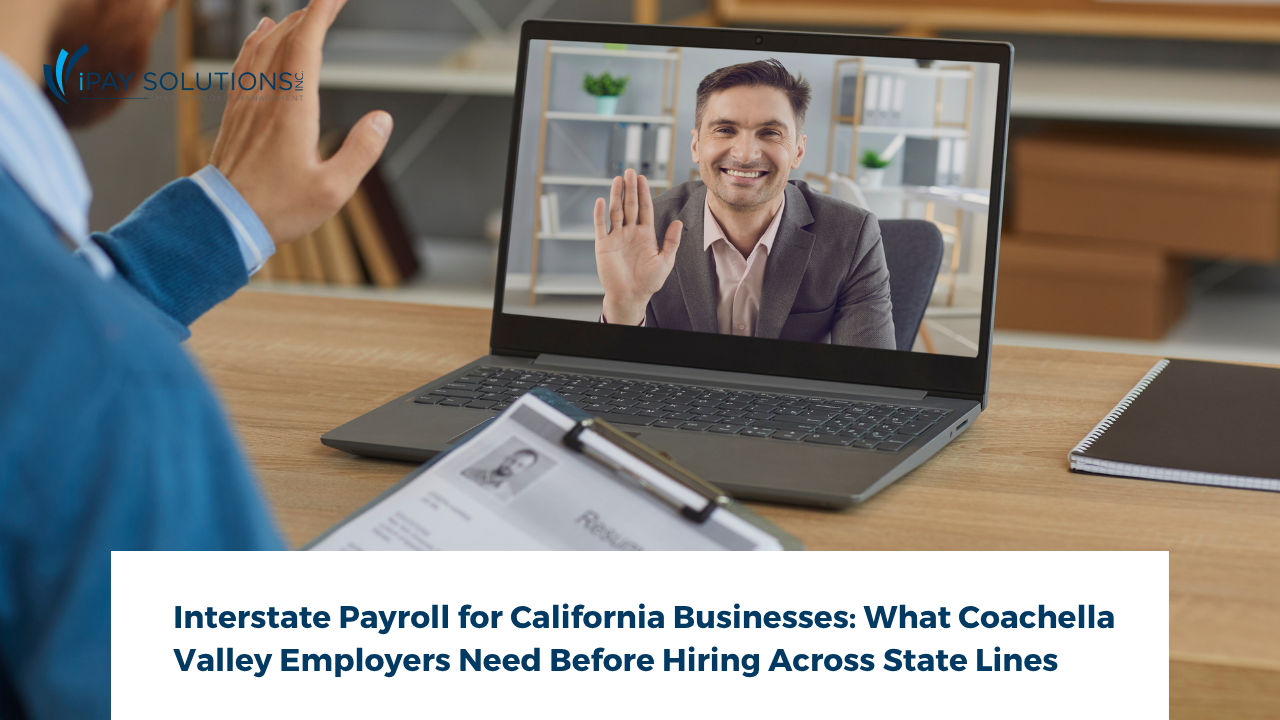
Growth is an exciting milestone, but the moment payroll crosses a state line, complexity follows. A Coachella Valley business may run payroll seamlessly in California, yet encounter unexpected challenges when onboarding a remote employee, hiring a traveling sales representative, or expanding into another state.
Interstate payroll introduces new layers of compliance, ranging from tax withholding rules to registration requirements and HR coordination. Many businesses don’t anticipate these hurdles until they are already in motion.
This guide breaks down what interstate payroll means for California employers, what to prepare before hiring across state lines, and how the right payroll and HR support can simplify expansion.
What Interstate Payroll Means for a California Business
Interstate payroll refers to managing employee compensation, taxes, and compliance when team members work outside the employer’s home state.
For California-based companies, this means:
- Handling multiple state tax systems
- Registering in new states as an employer
- Following different labor laws and wage requirements
- Managing varying reporting deadlines and formats
California already has some of the most complex payroll regulations in the country. Adding another state introduces a second (or third) set of rules that must be followed simultaneously.
Even a single out-of-state employee can trigger these obligations.
When a Coachella Valley Employer Usually Runs Into Interstate Payroll Issues
Many businesses don’t plan for interstate payroll, they stumble into it during growth.
Common scenarios include:
- Hiring a remote employee who lives outside California
- Expanding operations into a neighboring state
- Employing traveling or hybrid workers
- Retaining an employee who relocates out of state
At first, payroll may seem unchanged. However, compliance risks begin immediately if proper registrations and tax setups are not completed.
Delays or oversights can lead to:
- Incorrect tax withholding
- Penalties for unregistered payroll activity
- Misclassification of employee work locations
- Reporting inconsistencies
These issues often surface after payroll has already been processed—making them harder and more costly to fix.
The First Payroll and HR Questions to Answer Before You Hire Across State Lines
Before onboarding an out-of-state employee, California employers should pause and answer a few critical questions:
-
Where is the employee officially working?
The physical work location determines tax obligations—not the company’s headquarters.
-
Is employer registration required in that state?
Most states require businesses to register before running payroll for employees working within their borders.
-
What are the state-specific tax withholding rules?
Each state has its own income tax structure, unemployment insurance requirements, and employer contributions.
-
Are there unique labor laws to follow?
Minimum wage, overtime rules, and paid leave policies vary significantly between states.
-
How will payroll and HR systems adapt?
Existing processes must be able to handle multiple jurisdictions without manual workarounds.
Answering these questions early helps prevent compliance gaps and ensures a smoother onboarding experience.
Interstate payroll support from iPay Solutions
How Multi-State Payroll Changes Tax Setup, Withholding, and Reporting
Once a business enters multi-state payroll, tax management becomes more layered.
Key changes include:
State Tax Withholding
Employers must withhold income taxes based on the employee’s work state—not California. Some states have reciprocal agreements, while others do not.
State Unemployment Insurance (SUI)
SUI is typically paid to the state where the employee works. Determining the correct state can depend on multiple factors, including work location and residency.
Employer Registration
Businesses often need to register with:
- State tax agencies
- Workforce or labor departments
- Unemployment insurance programs
Reporting Requirements
Each state has unique filing schedules, forms, and electronic submission requirements. Employers can also review the IRS Publication 15, Employer’s Tax Guide for a federal overview of withholding, depositing, reporting, and paying employment taxes.
Without a structured system, managing these variables manually can quickly become overwhelming for small and midsize teams.
Where Timekeeping and HR Processes Start to Matter More
As payroll expands across state lines, timekeeping and HR coordination become more critical than ever.
Different states may require:
- Specific meal and rest break tracking
- Overtime calculations based on local laws
- Paid sick leave accrual tracking
- Employee recordkeeping standards
Manual time tracking or disconnected systems increase the risk of:
- Payroll errors
- Compliance violations
- Employee disputes
A unified system that connects timekeeping, payroll, and HR helps ensure that data flows accurately and consistently across all states.
How iPay Solutions Helps California Employers Manage Interstate Payroll
For Coachella Valley businesses, having a local partner with both technology and personalized support can make a significant difference.
iPay Solutions provides a structured approach to interstate payroll by combining advanced systems with one-on-one service.
Key advantages include:
Customized Payroll Solutions
Payroll systems are tailored to match the complexity of multi-state operations—whether a business is adding one out-of-state employee or expanding into multiple regions.
Flexible, Cloud-Based Access
Payroll can be managed from any device, making it easier to oversee employees working in different locations.
Integrated Time and Attendance
Accurate time tracking supports compliance with varying state labor laws and reduces manual calculations.
HR Support Resources
Access to HR tools, guidance, and professional networks helps businesses navigate changing regulations and employment requirements.
Employee Self-Service
Employees can manage pay stubs, tax forms, and personal information, reducing administrative workload.
This combination of technology and personalized support helps businesses stay compliant without overloading internal teams.
Build a Strong Interstate Payroll Process Early
Interstate payroll is where growth starts to expose weak systems. Once your business moves beyond a California-only team, payroll, HR coordination, and compliance become harder to manage with shortcuts and guesswork. The sooner you build a process for out-of-state hires, the easier it is to protect your team, your reporting, and your time. If your Coachella Valley business is preparing to hire across state lines, iPay Solutions can help you build a cleaner payroll process from day one. Reach out to our team to talk through your next hire and see how local support can make expansion easier.